
Last updated October 16, 2026
 AC repair
 Furnace & heating
 Heat pumps
 Ductless mini splits
 Trane
Trane Goodman
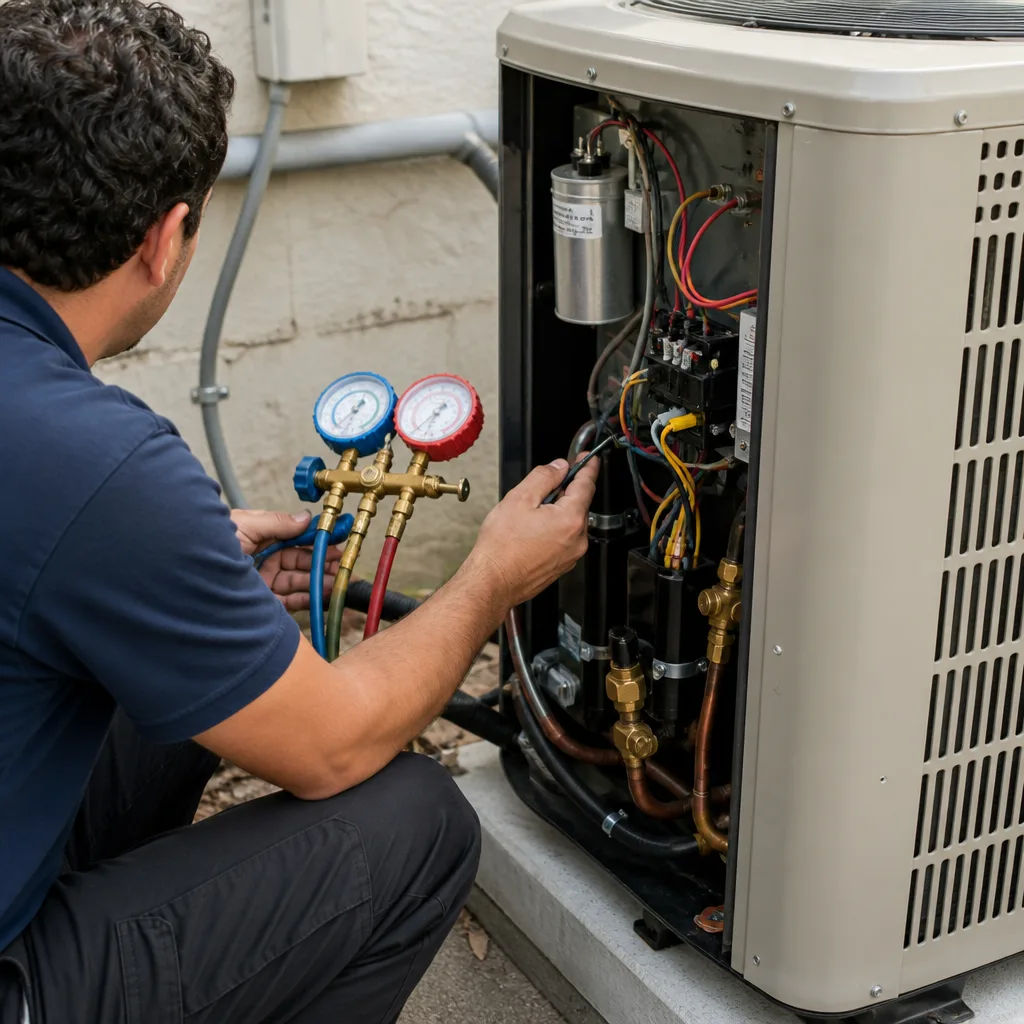
Seasonal tune-up and full diagnostic on your Carrier, Trane, or Goodman system - readings shown to you before any repair is proposed
Diagnosis first, numbers second - you approve the repair price before a single part goes in.
Get your free estimateHVAC Warning Signs: A Fort Lauderdale Homeowner’s Reference Guide
Ice on your refrigerant line is not always an emergency. More often than not in Fort Lauderdale, it’s a dirty air filter restricting airflow, and swapping in a fresh one for about $12 resolves the issue in twenty minutes. But ice on the outdoor unit’s compressor housing is a different symptom entirely. That can signal a refrigerant overcharge, and ignoring it for even a few days can destroy the compressor, turning a $300 repair into a $4,000 replacement. Same visual cue, opposite response required. This guide-along with our Complete Guide to HVAC in Fort Lauderdale-sorts Fort Lauderdale HVAC warning signs into three tiers so you know when to shut the system down today, when to book a visit this week, and what to simply log and monitor. You’ll learn which symptoms most guide articles get wrong, what our coastal climate does to equipment that inland homeowners never see, and how to run a basic performance check with an inexpensive tool you may already own.
Quick Answer
The most urgent HVAC warning signs in Fort Lauderdale are a burning smell coming through the vents, refrigerant hissing at the outdoor unit, a breaker that trips again immediately after you reset it, and water actively dripping into your living space from the air handler. Each of those requires shutting the system off at the thermostat and calling a technician the same day. Less urgent symptoms like cool-but-not-cold supply air, short-cycling, or rattling at startup can be scheduled within the week. Gradual changes like a slowly rising light bill or one weak register are worth logging and monitoring before you spend on a service call.
Styles & brands we work with
Table of Contents
- Tier 1: Shut the System Off and Call Today
- Tier 2: Schedule Within the Week
- Tier 3: Log, Monitor, and Review Monthly
- South Florida-Specific Warning Signs You Won’t Find in Generic Guides
- How to Run a Basic Performance Check Yourself
- What Warning Signs Mean for Repair vs. Replacement in Fort Lauderdale
- Common Mistakes to Avoid
- When to Call a Professional
Tier 1: Shut the System Off and Call Today
These four symptoms are the HVAC version of a check-engine light combined with smoke coming from under the hood. The right move is the same for all of them: turn the system off at the thermostat, flip the breaker only if you need to cut power, and call a technician. Do not run the system overnight and hope it improves. In Fort Lauderdale’s summer heat, the temptation to keep a limping AC running is strong. Don’t. A $200 repair becomes a $2,500 compressor swap when a small problem runs unattended for days or weeks.
Burning Smell From the Vents
A burning smell that starts when the system kicks on and persists for more than a few minutes is an electrical issue, not a dusty-element issue. Dust on heat strips produces a brief, mild odor that fades. A smell that intensifies or carries a distinct acrid, plastic, or fishy undertone means a wire, capacitor, or fan motor is overheating. A capacitor that fails under load is one of the most common service calls we see in Fort Lauderdale, especially during the July through September peak-load season when systems run 12 to 16 hours a day. Treat this as active electrical risk. Shut it down.
Refrigerant Hissing at the Outdoor Unit
If you hear hissing, gurgling, or bubbling at the outdoor condenser while the system runs, that’s refrigerant escaping from a compromised line, valve, or coil. Refrigerant systems are sealed. Any audible flow means the seal is broken. Running a system low on refrigerant does two things at once: it forces the compressor to work harder against reduced cooling capacity, and it lets moisture and air into the line, which creates acid inside the compressor. Acid is what kills compressors, not the low refrigerant itself. Shut the system off and call for a leak test. And no, topping off the charge without finding the leak is not a repair. It’s a bandage that leaks again, and in Florida, EPA rules require technicians to locate and repair leaks above a certain size rather than just recharging.
Breaker Tripping Immediately on Reset
Go to the panel. Find the breaker labeled for the air handler or condenser. Reset it once. If it holds and the system runs normally, you likely experienced a transient spike, and it’s worth noting the date and circumstances. If it trips again within minutes, or trips the moment the compressor tries to start, stop resetting it. A compressor or fan motor drawing locked-rotor amperage can overheat, and you’re not going to fix it with a third reset. This might be a failing capacitor, a grounded compressor winding, or a shorted crankcase heater. All three are repairable, but only if you stop cycling power through a faulted component. Call a technician and tell them exactly what happened: which breaker, how long it ran, and how many times you reset it. That detail narrows the diagnostic before they even arrive.
Water Actively Dripping Into Living Space
Water dripping from the ceiling, down a wall, or pooling around the base of an air handler in a closet is a drain-line or pan failure. Air conditioners in Fort Lauderdale produce gallons of condensate every day. A clogged condensate line, a cracked plastic drain pan, or a frozen and then thawed evaporator coil can all send that water somewhere it should not go. If water is reaching drywall, insulation, or wood framing, every hour matters. Shut the system down, catch the water in a bucket if you can, and call. This is also the warning sign with the highest secondary cost: a few hundred dollars in drain-line service versus tens of thousands in mold remediation if water sits in a Fort Lauderdale ceiling cavity for a week.
Tier 2: Schedule Within the Week
Tier 2 signs do not require an emergency call, but they do mean something is wrong or drifting out of spec. Schedule service within five to seven days. None of these will destroy your system overnight. All of them, left for months, will shorten equipment life or raise operating cost enough to matter.
Short-Cycling: System Runs Fewer Than 8 Minutes Per Cycle
Short-cycling means the compressor starts, runs briefly, shuts off, then starts again far more often than it should. In Fort Lauderdale’s cooling season, a properly sized system runs 12 to 20 minutes per cycle during peak afternoon heat. If your system is cutting off after five or six minutes while the house hasn’t reached the thermostat setpoint, you’re short-cycling. Common causes include an oversized system, a refrigerant overcharge, a thermostat placed in direct sun, or a failing run capacitor. Each start puts mechanical stress on the compressor. A system that starts 18 times an hour instead of 4 times wears out years early. This is a diagnostic appointment, not an emergency, but don’t let it ride through the summer.
Cool But Not Cold Supply Air
Here’s the test. Pick up an inexpensive infrared or probe thermometer for about $25. Measure the air temperature at a return grille, then at the supply register nearest the air handler. A system running correctly in cooling mode produces a temperature split of 15 to 20°F. If your return air is 76°F, supply air should come out between 56°F and 61°F. If your split is 10 to 14°F, the system is cooling, but underperforming. Causes include low refrigerant, a dirty evaporator coil, a failing compressor valve, or duct leakage pulling hot attic air into the return. A 14°F split is not an emergency. But it means you’re paying for cooling you’re not getting, and the problem tends to get worse rather than stabilize. Note the split, note the outdoor temperature, and tell the technician when you call. In our experience, that one measurement saves half an hour of diagnostic time.
Unusual Rattling at Startup
A rattle in the first 30 seconds of operation that fades as the system runs is often a compressor mounting bolt, a loose fan guard, or debris in the outdoor cabinet. A rattle that persists likely means a bearing in the condenser fan motor. A rattle that turns into a screech means the bearing is failing and the fan will seize. Intermittent rattles are hard to diagnose because they may not be present when the technician arrives. Record the sound on your phone. A 15-second recording of the exact noise is genuinely useful, and it keeps you from paying for a diagnostic on a system that behaves perfectly the day we’re there. Schedule it this week. Wait until the fan seizes and you get to buy a new motor in August, when you’d rather not.
Tier 3: Log, Monitor, and Review Monthly
Tier 3 symptoms are not malfunctions. They’re data points. The right response is to note them, watch them for 30 days, and only escalate if the trend worsens. This is the tier where overreacting costs money and underreacting costs more later. Make a note on your phone or on a paper tag dated with the observation. If a month from now the symptom is unchanged, mention it at your next maintenance visit and keep watching. Our AC Repair Maintenance Checklist for Fort Lauderdale Homeowners has a simple logging format you can use.
Gradually Rising Utility Bills With No Usage Change
A 5 to 10 percent increase over the same month last year, after accounting for weather, can just mean a mild refrigerant undercharge or a dirty condenser coil. It can also mean your system is gradually losing efficiency as the compressor ages or duct seals degrade. Don’t call someone based on one month’s bill. Look at the trailing three months. If the pattern holds or worsens, schedule a maintenance visit with a specific instruction: check refrigerant charge and coil condition. That’s a targeted diagnostic, not an open-ended service call. In Fort Lauderdale, where air conditioning can be 60 percent of a summer electric bill, small efficiency losses turn into real dollars over a cooling season.
Indoor Humidity Above 60 Percent in Auto Mode
South Florida air is humid, and your air conditioner is the primary dehumidifier in the house. When the system runs in “auto” mode, it should hold indoor relative humidity between 45 and 55 percent. Sustained readings above 60 percent with the system running normally suggest one of three things: the system is oversized and cools too fast to pull moisture out, the fan is set to “on” instead of “auto” (which blows water back off the coil), or the system is short-cycling for the reasons in Tier 2. Humidity that hangs at 65 percent or higher indoors, around the clock, promotes mold and dust mites. This one is especially relevant in Fort Lauderdale neighborhoods with older, block-construction homes that hold moisture differently than newer construction. Log it, confirm the fan setting, and if it persists, book a maintenance visit and ask about dehumidification options.
Weak Airflow From One or Two Specific Registers
If one register in the back bedroom blows noticeably weaker than the others, you have a duct issue, not a system issue. The causes are almost always localized: a collapsed flex duct, a damper that has slipped, a duct that has separated at a joint, or a register that someone partially closed to balance another room. Feel the airflow with your hand, then open and close that register blade to confirm it’s actually moving. If the weak register is the farthest from the air handler, you may just have long duct-run losses, which is a design issue, not a failure. Note which register and how long it’s been weak. If it worsens, a technician can scope that duct during a normal visit without you paying for a separate trip.
South Florida-Specific Warning Signs You Won’t Find in Generic Guides
Generic HVAC warning-sign lists are written for a national audience. They miss the things that salt air, humidity, and coastal soil do to equipment here, which is why we also published a Seasonal HVAC Care for Fort Lauderdale: Year-Round Homeowner’s Guide. In Fort Lauderdale, these two symptoms are the ones we see discussed online the least and repaired in the field the most.
White Efflorescence on Refrigerant Line Fittings
You know what white, chalky, crystallized salt looks like on a concrete block retaining wall near the beach. That’s efflorescence, minerals left behind when moisture wicks through masonry and evaporates. When you see a similar white or pale crust forming on the copper fittings, service valves, or the U-bends of your outdoor condenser, treat it as a refrigerant leak until proven otherwise. Here’s why: refrigerant oil leaks out with the refrigerant, and it carries a trace of lubricant. The oil wets the fitting, then dust and salt from coastal air stick to it and build up. Over months, that crust grows. Inland guides won’t mention this because inland air is cleaner and drier. In Fort Lauderdale, within a few miles of the coast, salt-laden air makes this sign visible earlier and more distinctly. If you see white crust on a line fitting and the system is a few years old, schedule a leak test. This is not surface rust, and it does not wipe off and stay off.
Coastal Corrosion on Outdoor Fins and Coil Guards
Everything outdoors in Fort Lauderdale corrodes. The real question is whether the corrosion is cosmetic or functional. When the aluminum fins on your condenser coil develop a white, powdery surface or the coil guard turns brown and flakes, you’re seeing normal coastal aging. But when visible pitting appears on copper line sets, or when fins begin to rot away entirely rather than just discolor, the corrosion is working on the sealed system itself. A pinhole in a copper line caused by salt corrosion is common along the barrier islands and within a few miles of the coast. The fix is usually a brazed repair at the leak point and a recharge, which most Fort Lauderdale homeowners will face once in the life of a system. The prevention is keeping the coil clean and rinsed with fresh water a few times a year, particularly after storms that carry salt spray inland.
How to Run a Basic Performance Check Yourself
Before you call about any Tier 2 or Tier 3 symptom, run this check. It takes ten minutes and gives the technician two hard numbers instead of vague symptoms. It also separates “the system feels off” from “the system is measurably off,” which saves you the cost of a diagnostic on a system that’s actually fine.
- Check the air filter first. In cooling season, a standard 1-inch filter in a Fort Lauderdale home needs replacement every 30 to 45 days. If you run the AC nearly year-round (most of us do), a monthly cadence is not excessive. A clogged filter causes about a third of the “cooling problem” calls we get. Swap in a new one, run the system for 30 minutes, then re-evaluate. If the symptom is gone, you just fixed it for twelve bucks.
- Calm the house to a stable temperature. Set the thermostat to 76°F and let the system run for at least 20 minutes. The measurements only mean something if the system has reached a steady run, not the first minute after startup.
- Measure the return air temperature. Stand at a central return grille (not right next to a supply register) and point an infrared or probe thermometer into the airflow for 30 seconds. Record the stable reading. This is your return temperature.
- Measure the supply air temperature at the nearest register. Walk to the supply register closest to the air handler and take the same measurement. Record it. This is your supply temperature.
- Do the math. Subtract supply from return. The target is a 15 to 20°F split. If you measure 74°F return and 58°F supply, that’s a 16°F split, and the refrigerant side is doing its job. If you measure 74°F return and 66°F supply, the split is 8°F, and you have a charge, compressor, or airflow problem worth investigating.
- Write down the numbers and the date. On the next service call, hand the technician the log. Concrete numbers tell us more than “it’s not cold enough.” And if you call AC repair in Fort Lauderdale with these measurements, the scheduler can often give you a better sense of what to expect before anyone arrives.
What Warning Signs Mean for Repair vs. Replacement in Fort Lauderdale
Some symptoms push you toward a repair call. Some push you toward a replacement conversation. Here’s the honest framework we use with homeowners, and it doesn’t start with the price of a new system. It starts with three questions: How old is the equipment? What’s the compressor’s condition? What will the next five years cost in repairs and efficiency loss?
If your system is under 10 years old and the symptom is a single-point failure, like a capacitor, contactor, drain issue, or a small refrigerant leak that can be located and brazed, repair is almost always the right call. Modern systems, when maintained, routinely reach 12 to 15 years in Fort Lauderdale, even with coastal exposure. We service all major brands, including Trane, Lennox, and Rheem systems, and we see well-kept units from all three performing fine into their second decade.
If your system is 12 years or older and the symptom involves the compressor, the evaporator coil, or a refrigerant leak inside the coil, replacement becomes a serious consideration. A new compressor for an aging system often costs 40 to 60 percent of a complete new system, and the old coil, fan motor, and electrical components remain, ready to fail next. We don’t push replacement as a default. We write up the two options with real numbers, and the homeowner decides. But when a Goodman or Lennox system from 2012 has a failed compressor and a corroded coastal coil, an honest cost conversation usually favors replacement over a repair that buys 18 months.
For reference, in Fort Lauderdale, most repairs run $150 to $450 for common parts like capacitors, contactors, drain-line service, and minor electrical work. Compressor-level work on a standard split system runs $1,800 to $3,200 including refrigerant. A full system replacement typically ranges from $6,500 to $14,000 depending on size, efficiency tier, and brand. Those are wide ranges because Fort Lauderdale homes vary dramatically in size, duct condition, and panel capacity. A written quote with a fixed price is the only number that matters for your house.
If replacement looks likely, the conversation includes heat pump installation in Fort Lauderdale as an option alongside a conventional AC and electric heat strip setup. Heat pumps make increasing sense in South Florida because they provide cooling and a mild-heating function at a lower operating cost than strip heat in our short but real winter.
Common Mistakes to Avoid
- Adding refrigerant without finding the leak. A technician who only tops off a low system without a leak search is selling you a patch, not a repair. In Fort Lauderdale, where systems run nearly year-round, small leaks get worse quickly. The Garrison Standard at our shop means a repair is guaranteed in writing for a full year, and a recharge with no leak search does not meet that bar.
- Ignoring a breaker trip and resetting repeatedly. A breaker is doing its job. It trips to protect the wiring and the equipment. Resetting it three times without diagnosis turns a $60 capacitor replacement into a possible $2,500 compressor failure.
- Running the system with the filter removed to “get more airflow.” A system without a filter pulls unfiltered air across the evaporator coil. That dust and lint mix with condensate and form a mat on the coil that restricts airflow worse than the dirty filter did. Then the coil has to be removed and cleaned, which is a $400-plus repair, not a $12 fix.
- Measuring cooling by hand-feel at the register. A vent can feel “cool” and still be 8°F short of a proper temperature split. Use a thermometer. It’s a $25 tool that pays for itself the first time you call with a real measurement instead of a feeling.
- Waiting weeks on a humidity complaint because “the AC still cools.” High indoor humidity in a Fort Lauderdale home is a problem that compounds. Mold grows in the time you wait. If humidity is stuck above 60 percent for two consecutive weeks, schedule the visit, even though it’s not an emergency in the traditional sense.
- Assuming a hissing sound is “just the refrigerant moving.” Refrigerant systems are sealed and quiet. A healthy system does not make audible hissing at the lines. Hissing is a leak or a restriction, and both need a professional.
- Replacing the system based on one expensive quote without a load calculation. Some contractors quote a new system based on square footage rules of thumb. Fort Lauderdale homes with block walls, large east or west glass, and varying insulation need a proper Manual J load calculation. A system oversized by half a ton short-cycles and leaves the house clammy. A system undersized runs constantly in August and never hits setpoint. Ask for the load calculation before you sign.
When to Call a Professional
Any Tier 1 symptom means you call today. Tier 2 symptoms mean you call this week. Tier 3 symptoms mean you monitor and call when the trend worsens or when you’re due for a maintenance visit anyway. What you should never do is ignore a Tier 1 sign because you’re worried about the cost of a service call. The cost of the call is small and usually fixed. The cost of ignoring a burning smell, a hissing line, or a breaker that keeps tripping is often a full system replacement.
Dalton Heating & Air Fort Lauderdale offers free estimates for repair and replacement work in Fort Lauderdale. Every visit includes a written price before any work starts, and every repair carries a written guarantee for a full year. If the repair fails in that year, we return at no charge. Call Dalton Heating & Air Fort Lauderdale home at (754) 354-6972 to schedule a diagnostic or get a second opinion on a quote you’ve received.
See the difference
 Before
 After
After Before
 After
After Before
 After
AfterFrequently Asked Questions
The four symptoms that require an immediate shut-down and same-day call are a persistent burning smell through the vents, hissing or bubbling at the outdoor refrigerant lines, a breaker that trips again right after you reset it, and water actively entering living space from the air handler. Any one of these points to electrical, sealed-system, or structural water damage risk. For same-day service in Fort Lauderdale, call (754) 354-6972 and tell the dispatcher which of these you’re seeing.
Use a digital or infrared thermometer and measure the temperature at a main return grille and at the supply register nearest the air handler after the system has run for 20 minutes. The supply air should be 15 to 20°F colder than the return air. A split smaller than that means the system is underperforming, usually due to low refrigerant, a dirty coil, or duct leakage. If you’re not sure how to interpret your readings, a quick maintenance call in Fort Lauderdale will settle it.
In Fort Lauderdale’s peak summer heat, a correctly sized system may legitimately run for long stretches in the late afternoon. But if it runs nonstop from noon to midnight and never reaches the setpoint, the system is undercharged, undersized, has a dirty condenser coil, or is losing cool air through duct leaks. This is a Tier 2 symptom: not an emergency, but schedule it within the week and try to note how long it runs and what the outdoor temperature was at the time.
Sometimes. If the failure is a capacitor, contactor, or drain-line issue, a 15-year-old system that has been well-maintained may have another two or three seasons in it. If the failure is the compressor, the evaporator coil, or a refrigerant leak inside the coil, the repair cost often approaches half the price of a new system, and the remaining components are already at end of life. We write up both repair and replacement options with numbers and let you decide.
Yes. Salt accelerates corrosion on aluminum condenser fins, copper line sets, electrical connections, and the coil guard itself. Homes within a few miles of the Fort Lauderdale coastline show faster coil and fitting corrosion than inland homes. Coated coils, regular rinsing with fresh water, and prompt attention to white crust forming on line fittings all buy meaningful service life in salt exposure areas.
In Fort Lauderdale, most “heating” is done with electric strip heat inside an air handler, and a furnace is rare in older homes. If you do have a furnace and it fails, the economics usually favor switching to a heat pump, especially if the furnace is older and the AC side of the system is also aging. A heat pump handles both cooling and the mild South Florida heating season more efficiently than strip heat or an aging furnace. For details, see our furnace repair in Fort Lauderdale page or ask us about heat pump conversion when you call.
The Bottom Line
Most HVAC problems announce themselves early, and the warning signs fall into three clear tiers. Burn, hiss, trip, or flood: shut it down and call today. Short cycles, weak temperature split, or rattling at startup: schedule within the week and get ahead of a cascade. Rising bills, persistent humidity, or one weak register: write it down, watch it for a month, and bring the log to your next maintenance visit. The common thread in every Fort Lauderdale HVAC failure we’ve seen is that someone noticed something early and waited too long to act on it. The fix for that is simple: know which tier a symptom falls into, respond proportionally, and use a contractor who puts the price in writing before any work starts and stands behind the repair for a full year. For more guides & resources on keeping your system running, visit our blog.
If you’re seeing something on this list and want a straight answer on what it means for your system, call Dalton Heating & Air Fort Lauderdale at (754) 354-6972. We’ll help you sort emergency from scheduled-service over the phone, and every repair comes with a written price before work begins and a free return visit if the repair fails within the year. That’s The Garrison Standard, and it’s been the operating rule since 2003.
Written by Marco Benitez, Owner at Dalton Heating & Air Fort Lauderdale, serving Fort Lauderdale since 2003.